
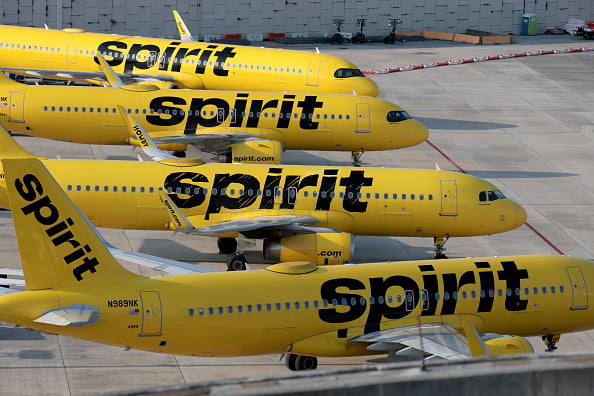
Spirit Airlines was the poster child for customer frustration — an airline that charged passengers for everything except oxygen. Social media and mainstream outlets were filled with jokes and cringeworthy videos about the airline, leaving many travelers wondering whether enduring the hassle was worth the cheaper fare.
On May 2, 2026, Spirit Airlines ceased all operations after multiple failed restructuring attempts. Customers were stuck at airports due to sudden cancellation announcements. In addition, customers who planned their flights to see important events like the World Cup will have to rearrange their travel plans.
While many are happy to say “good riddance” to its notoriously poor service, is its disappearance actually good for consumers? Let’s examine how Spirit operated, how it disrupted the industry, why it ultimately failed, and what higher fares may await us in a post-Spirit world.
Spirit followed the ultra-low-cost carrier (ULCC) business model. While its “no-frills” approach became infamous, the airline cut costs in several other ways. It operated a single aircraft type — the Airbus A320 family — which simplified maintenance and training. Like other ULCCs, Spirit purchased planes in bulk for better pricing and leased others for favorable tax and accounting treatment. It also negotiated favorable deals with smaller airports.
In its early years, Spirit was consistently profitable and maintained one of the best safety records in the industry, with no fatal passenger crashes in its 34-year history. This proved that, despite widespread complaints and memes, enough passengers were willing to tolerate the inconveniences in exchange for lower fares. In response, major airlines introduced their own “basic economy” fares, which typically prevent seat selection and free checked or carry-on bags.
Spirit and other ULCCs like Frontier successfully pushed ticket prices down by offering genuine low-cost alternatives. However, they also created widespread annoyance through aggressive “nickel-and-diming.” Practices such as charging for printing boarding passes and enforcing strict carry-on size limits — often poorly disclosed on third-party sites like Expedia — led to consumer backlash. One notable class-action lawsuit over surprise bag fees was eventually settled.
Spirit’s profitability ended with the COVID-19 pandemic. Nationwide travel restrictions grounded most flights and devastated revenue. The airline never fully recovered to pre-COVID levels and was weighed down by heavy debt.
In 2022, Frontier attempted to acquire Spirit, but the deal was rejected by shareholders. JetBlue then tried to buy the company, only for the Department of Justice to block the merger on antitrust grounds. A federal court upheld the government’s decision.
Spirit filed for Chapter 11 bankruptcy protection in late 2024 (emerging in early 2025), then filed again in August 2025 with approximately $8.1 billion in debt. The federal government considered a bailout, but negotiations collapsed. Spirit ultimately cited surging jet fuel prices caused by the Iran conflict as it ceased operations.
Was the government wrong to block the JetBlue merger? In hindsight, many analysts believe yes. The DOJ acted to preserve competition and protect consumers, but the decision only delayed the inevitable.
Should the government have acquired Spirit? Officials cited the desire to protect jobs (roughly 14,000-17,000 including contractors). Spirit also released optimistic projections claiming it could return to profitability by 2027. But since Trump has extensive experience with bankruptcies through his companies, he likely knew a bad bet when it saw it.
Since Spirit Airlines has given up the ghost, other ULCCs will need to rethink their models, especially their heavy dependence on volatile fuel prices. A better low-cost model may already exist: Zipair Tokyo, a subsidiary of Japan Airlines. Despite being a low-cost carrier, Zipair earns strong reviews for fair add-on pricing, free Wi-Fi in economy, and modern Boeing 787 aircraft. In 2025, it achieved an impressive 17% operating margin.
While low-cost carriers like Spirit aren’t for everyone, they left a lasting mark on the industry. To survive long-term, future ULCCs must reduce excessive nickel-and-diming and become less vulnerable to fuel price spikes.
Steven Chung is a tax attorney in Los Angeles, California. He helps people with basic tax planning and resolve tax disputes. He is also sympathetic to people with large student loans. He can be reached via email at stevenchungatl@gmail.com. Or you can connect with him on Twitter (@stevenchung) and connect with him on LinkedIn.
The post Why Spirit Airlines Failed — And Why You Might Miss It appeared first on Above the Law.