
Justice Amy Coney Barrett ended the Supreme Court’s 2023 term with two dissents that complicate the usual descriptions of her jurisprudence. In Ohio v. EPA, decided on June 27, 2024, Barrett joined the Court’s three liberal justices in opposing emergency relief from a major environmental regulation. One day later, in Fischer v. United States, she joined Justices Kagan and Sotomayor in arguing that a federal obstruction statute covered some conduct associated with the attack on the Capitol on January 6, 2021.
The two positions pointed in different directions. Barrett resisted judicial intervention in Ohio because the challengers were asking the Court to resolve a technically complex administrative dispute on an emergency record. “The equities counsel restraint,” she wrote, stressing that the Court was acting without full briefing or reasoned lower-court opinions. Her questions at oral argument had concentrated on the same problem. She asked whether the dispute was “cert worthy” in its existing posture and whether the vehicle problems identified by other justices should weigh against intervention.
In Fischer, Barrett thought the Court had been too restrained. Congress had enacted broad language prohibiting anyone from corruptly obstructing or impeding an official proceeding, and Barrett concluded that the majority had performed “textual backflips” to confine that language to evidence-related conduct. “Statutes often go further than the problem that inspired them,” she wrote, “and under the rules of statutory interpretation, we stick to the text anyway.” Her questioning at argument foreshadowed that conclusion. When the government hesitated to say whether a protester who stopped the electoral-vote count would violate the statute, Barrett cut through the qualification: “Yes. Say you can. You can. Just say you can.”
Together, the cases expose a judicial instinct that is easy to miss when Barrett is described simply as a conservative, an originalist, a proceduralist, or a former clerk to Justice Scalia. She often measures the reach of a proposed decision against the strength of the authority offered to support it. The technical record and emergency posture in Ohio could not carry the intervention the applicants sought, while the enacted language in Fischer could carry a broad interpretation even though that reading produced an unconventional coalition.
That distinction runs through Barrett’s voting, writing, and oral-argument questions. She repeatedly asks where the asserted authority comes from, which legal test governs, how far the proposed rule extends, whether it fits the record, and whether the case can be resolved through a narrower route. These questions do not consistently move her toward a liberal or conservative result. They help determine how much doctrinal or institutional reach she believes the available legal warrant can support.
The resulting jurisprudence can be understood as source-sensitive decisional calibration. Barrett begins from recognizable conservative and originalist premises, but she separately tests whether the Court’s reasoning and remedy are commensurate with the text, precedent, history, record, and procedural vehicle before it. That second inquiry helps explain why she usually votes with the Court’s conservatives, why she sometimes crosses conventional lines, and why she so often writes separately to qualify a majority she otherwise joins.Subscribe
A Conservative Justice Whose Coalitions Depend on the Subject
Barrett’s voting record has a clear center of gravity. Across 311 Supreme Court decisions in the Supreme Court Database, Justice Kavanaugh is her closest voting neighbor. They agreed in 83.6% of nonunanimous decisions and 77% of close decisions, with Chief Justice Roberts generally ranking second. Those observed coalitions place Barrett closer to Kavanaugh and Roberts than a measure based only on the ideology of appointing presidents would predict.
The overall numbers conceal substantial variation by subject. In judicial-power cases involving standing, jurisdiction, remedies, and the authority of federal courts, Barrett agreed with Kavanaugh in 95.2% of nonunanimous decisions and was on the prevailing side in 97.3% of all cases. That stability fits opinions such as Murthy v. Missouri, in which she required plaintiff-, defendant-, and platform-specific proof before permitting a sweeping injunction regulating government contacts with social-media companies.
Her First Amendment pattern is different. Justice Gorsuch becomes her closest colleague, agreeing with her in 91.7% of nonunanimous cases and in all seven close cases in the dataset. Barrett’s writings in this area also show a distinctive concern with how history becomes law. During oral argument in Vidal v. Elster, she repeatedly asked the government to identify the governing test: “Just tell me what the analysis is.” Her concurrence later rejected the proposition that historical tradition could resolve the constitutional question by itself. “A rule rendering tradition dispositive is itself a judge-made test,” she wrote, demanding a justification connecting the tradition to constitutional text, precedent, or the function of trademark law.
Economic and regulatory disputes produce her least stable coalitions. Barrett agreed with Kavanaugh in only 70.6% of nonunanimous cases classified as Economic Activity, a broad category encompassing administrative law, bankruptcy, commercial statutes, patents, and labor regulation. Nine of the 23 decisions in which Barrett joined at least two liberal justices while three conservative colleagues dissented arose in this category. Four of the five 5–4 majorities in which she disagreed with both Kavanaugh and Roberts also involved economic or regulatory statutes: Becerra v. Empire Health Foundation, National Pork Producers Council v. Ross, Harrington v. Purdue Pharma, and Medical Marijuana, Inc. v. Horn.
This concentration is worth observing because technical statutory cases often separate interpretive method from a justice’s expected policy alignment. The disputes may turn on the unit regulated by a statute, the remedy Congress authorized, the relationship between two provisions, or whether an agency and lower court developed an adequate record. Barrett’s attention to those questions can reinforce conservative outcomes, as it frequently does, but it can also pull her away from her usual partners when their preferred result demands a strained textual limitation or an expansive judicial remedy.
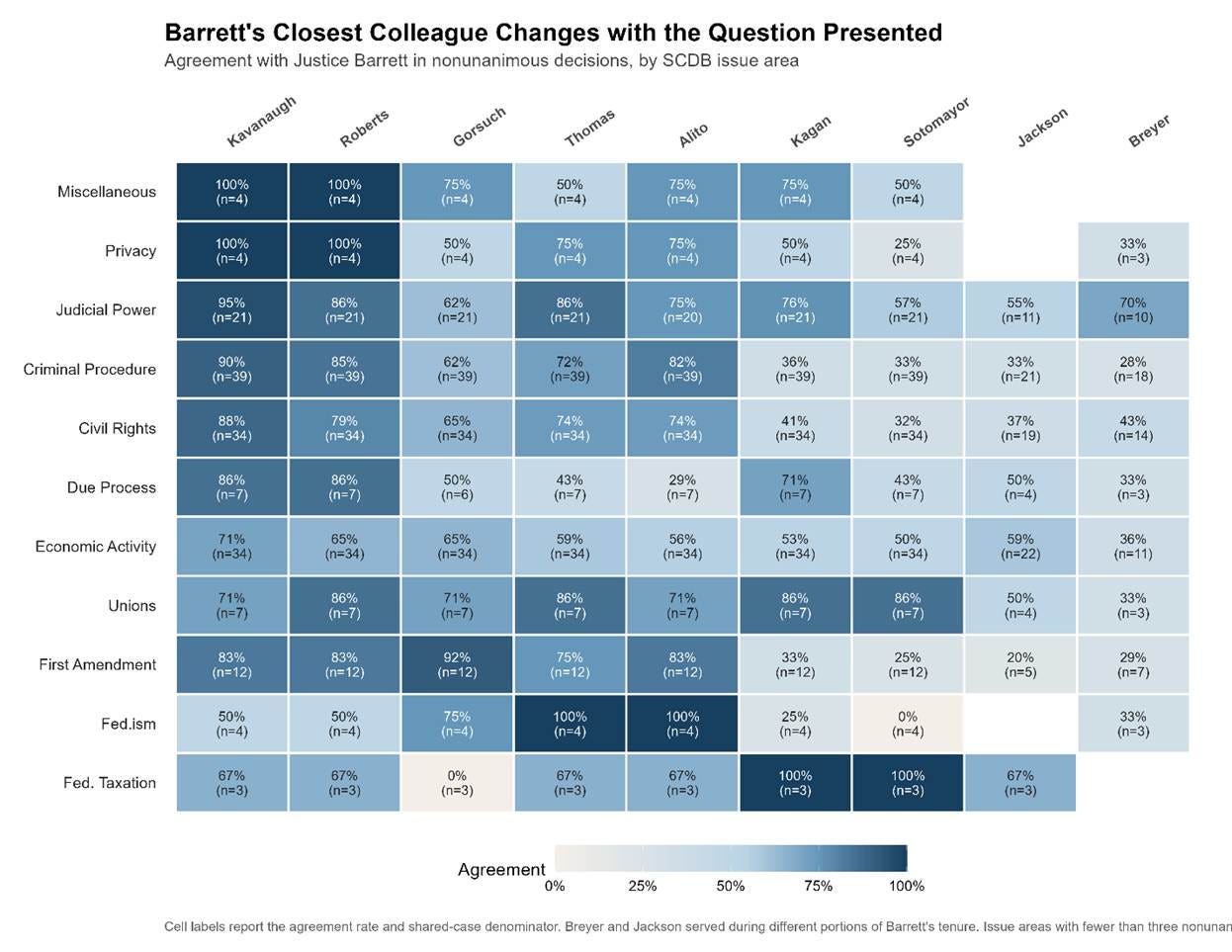
The issue-conditioned pattern does not make Barrett a general centrist or median justice. Her departures are concentrated in fields where legal categories, institutional authority, and remedial consequences are unusually contested. The more useful question is therefore not how often she breaks with the conservative bloc in the abstract, but which kinds of legal disputes make that break more likely. Economic and regulatory cases provide the clearest answer.
Where Barrett Is Most Likely to Break Ranks
Barrett’s unconventional votes cluster in economic and regulatory disputes, where statutory detail and remedial design can matter more than an easily identifiable ideological position. The Supreme Court Database places these cases in a broad Economic Activity category that includes administrative law, bankruptcy, patents, labor regulation, and commercial statutes. That breadth requires caution when describing the category as a unified field, but it also captures the type of dispute in which Barrett’s usual coalition is most likely to fragment.
Barrett agreed with Kavanaugh in only 70.6% of nonunanimous Economic Activity cases, well below their agreement in civil-rights, criminal-procedure, and judicial-power cases. Nine of the 23 decisions in which Barrett joined at least two liberal justices while three conservative colleagues dissented fall within the category. Four of the five 5–4 majorities in which she disagreed with both Kavanaugh and Roberts also arose there.
Those four cases do not share an obvious ideological position. In Becerra v. Empire Health Foundation, Barrett joined an opinion by Kagan interpreting the Medicare statute in favor of the federal government. In National Pork Producers Council v. Ross, she joined parts of Gorsuch’s fractured opinion rejecting a constitutional challenge to California’s regulation of pork sold in the state. In Harrington v. Purdue Pharma, she supplied the fifth vote for an opinion by Gorsuch holding that the Bankruptcy Code did not authorize releases extinguishing claims against the Sackler family without the claimants’ consent. In Medical Marijuana, Inc. v. Horn, she joined Gorsuch and the three liberal justices in concluding that the civil provisions of the Racketeer Influenced and Corrupt Organizations Act (RICO) permitted recovery for certain business or property losses flowing from personal injury.
The connective tissue is the definition of legal categories and the consequences attached to them. Barrett’s questions in National Pork Producers focused on whether the challengers’ theory would have “far-reaching consequences,” and her separate writing resisted a rule that could unsettle a wide range of state laws. In Medical Marijuana, she treated RICO’s reference to injury to “business or property” as a limitation on the type of loss recoverable rather than a categorical exclusion of any loss associated with personal injury. The statutory language defined the relevant boundary, even though the resulting coalition divided the Court’s conservatives.
Her liberal-direction dissents show the same concentration. Half of the eight such dissents in the dataset arose in Economic Activity cases, including HollyFrontier, Office of the U.S. Trustee v. John Q. Hammons, Ohio v. EPA, and City and County of San Francisco v. EPA. The results varied, but each dispute required the Court to decide whether a statute, record, or remedial rule could support the reach claimed by one side.
In San Francisco, the majority held that the Clean Water Act did not authorize certain “end-result” provisions in wastewater-discharge permits. Barrett joined the liberal justices in dissent, reasoning that regulated parties could challenge vague or unreasonable permit terms through ordinary administrative-law review. At argument, she asked whether a term that failed to give adequate notice would already be vulnerable as arbitrary and capricious. The availability of that remedy weakened the argument for a broader categorical restriction on the EPA’s authority.
Economic and regulatory cases therefore operate as a stress test for Barrett’s jurisprudence. Her ordinary conservative alignment remains visible, but the absence of a simple constitutional or ideological rule places greater weight on the enacted text, the precise remedy, and the relationship between the asserted authority and its consequences. Those considerations sometimes preserve her usual coalition and sometimes dissolve it.
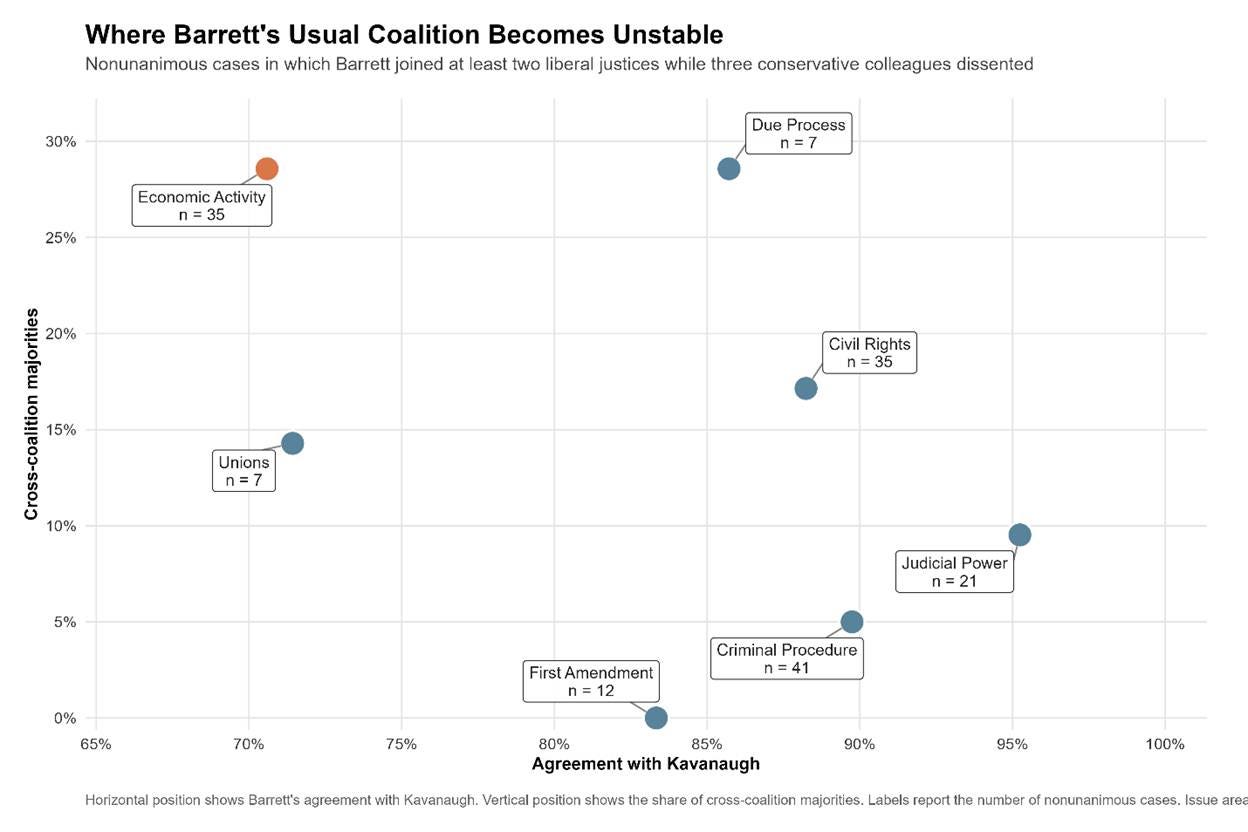
In the graph above, each point represents an issue area. Horizontal position shows agreement with Kavanaugh in nonunanimous decisions; vertical position shows the rate of strong cross-ideological majority votes. Point size reflects the number of nonunanimous cases, and color reflects Barrett’s separate-writing rate.
The Questions Barrett Keeps Asking
Barrett’s oral-argument questions repeatedly break a case into five components: the source of authority, the governing test, the limiting line, the fit between the rule and the record, and the appropriate disposition. Counsel may arrive with a broad theory of statutory or constitutional law, while Barrett often asks for the intermediate steps connecting that theory to the judgment the Court has been asked to enter.
The first question is frequently one of legal authority. During the argument in United States v. Tsarnaev, the government defended the supervisory power of federal appellate courts to impose procedural requirements on district courts. Barrett responded with six words: “Where does that authority come from?” Her concurrence returned to the same problem, concluding that the Court had “failed to identify a source for this supposed authority” and that no constitutional or statutory foundation was apparent. The procedural rule might have been sensible, but its usefulness could not create the institutional power needed to impose it.
The next question concerns the governing test. In Vidal v. Elster, the government relied heavily on the historical treatment of trademarks containing a living person’s name. Barrett repeatedly asked how that tradition became a First Amendment rule. “Just tell me what the analysis is,” she said after counsel avoided identifying the level of scrutiny that would apply in a related context. Her concurrence later explained why the missing step mattered: “A rule rendering tradition dispositive is itself a judge-made test.” History could provide evidence, but the Court still needed a jurisprudential reason for treating the historical practice as constitutionally controlling.
Barrett’s line-drawing questions then test whether the proposed test can be confined. In National Pork Producers, she asked whether the challengers’ dormant Commerce Clause theory would have “far-reaching consequences.” In Moody v. NetChoice, she tested the states’ social-media laws against platforms and functions as different as Etsy, Uber, Amazon Web Services, email providers, and conventional social-media feeds. Her concurrence concluded that determining the expressive character of every regulated function in a facial challenge was “a daunting, if not impossible, task.” The diversity of applications did more than complicate the analysis; it undermined the fit between a platform-wide constitutional rule and the activities actually regulated.
Questions about fit become especially prominent when the requested relief exceeds the evidence presented. In Murthy v. Missouri, Barrett pressed the parties on whether the Court could decide standing without revisiting the lower courts’ factual findings. Her majority opinion later rejected the treatment of plaintiffs, government officials, and social-media platforms as unified groups. “Standing is not dispensed in gross,” she wrote, requiring evidence connecting particular government conduct to particular platform decisions affecting particular plaintiffs. A record alleging broad government pressure could not support an equally broad injunction without those causal links.
The same concern can affect the procedural disposition rather than the underlying legal rule. In Moyle v. United States, Barrett asked whether the federal government had sued other states over the interaction between federal emergency-care requirements and abortion restrictions, and she emphasized that Idaho had changed its law after the Court granted review. Her concurrence concluded that the federal government had narrowed its position and that changes in state law had altered the dispute. Those developments made the case presented at argument materially different from the one the Court had agreed to decide, supporting dismissal rather than a nationwide ruling on the merits.
Barrett’s questions about source, test, line, record, and disposition often appear procedural because they concern how a court should decide a case. Their content reaches beyond proceduralism, however, because they determine which texts, precedents, historical practices, and institutional powers can legitimately support a legal rule. The questions also explain why her preference for narrower decisions has limits. When enacted language clearly covers the conduct before the Court, as she concluded in Fischer, the same method can produce an expansive result.
Oral Argument as an Early Draft of the Separate Opinion
Barrett’s oral-argument questions frequently identify the distinction that later organizes her separate writing. The connection sometimes appears in repeated language, as when her question about the source of appellate authority in Tsarnaev became a concurrence devoted to that authority. More often, the question and opinion share an analytical structure: identify the source, define its scope, test its fit with the case, and select a disposition that reaches no further than the source permits.
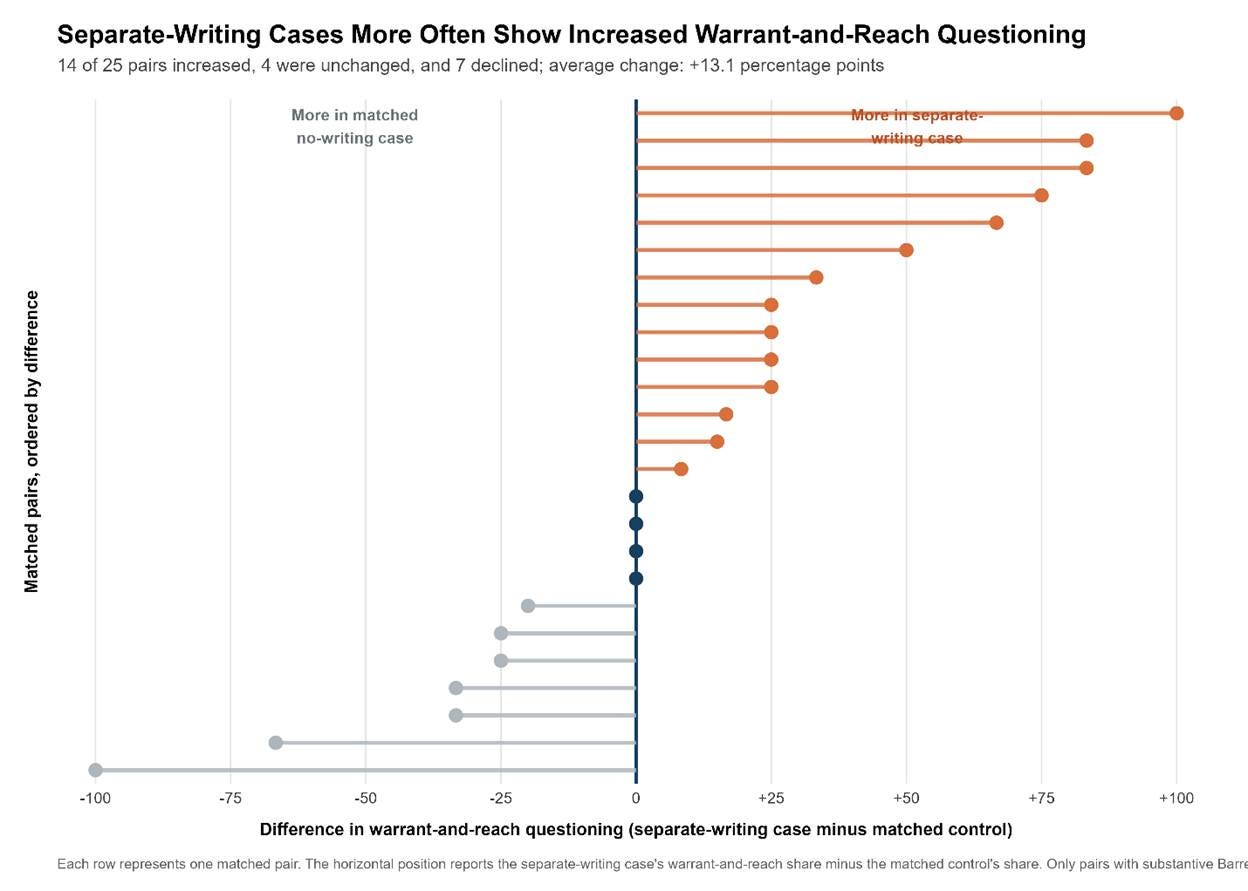
The pattern extends beyond individual examples. Barrett had 303 indexed speaking turns in the argued cases reviewed for this analysis, including 244 substantive interventions across 67 cases. Her questions in cases that produced a separate opinion devoted 42.5% of substantive turns to the source, scope, factual fit, or permissible reach of the proposed decision. The corresponding share was 24.1% in a group of matched cases in which she did not write.
A paired comparison reaches a similar result. Each of Barrett’s 34 separate-writing cases was matched with a no-writing case based on term, issue area, ideological direction, unanimity, vote margin, source of legal authority, and argument date. Barrett had substantive participation in both cases in 25 of those pairs. The share of her questions devoted to warrant and reach was higher in the separate-writing case in 14 pairs, the same in four, and lower in seven. Across the 25 pairs, the average difference was 13.1%.
The individual cases show what the aggregate captures. In Trump v. United States, Barrett asked whether the public-authority defense could protect legitimate presidential action without creating categorical immunity and whether prosecutors could proceed against private conduct while leaving official conduct aside. Her partial concurrence and dissent later adopted a similarly segmented approach: protect exercises of power conclusively assigned to the president, permit prosecution of private conduct, and evaluate other official acts as the case developed.
In Gutierrez v. Saenz, Barrett asked whether the standing analysis should track the prosecutor or the state court and what evidence established the prosecutor’s reason for resisting DNA testing. Her separate writing later disaggregated the same causal chain, asking which government actor produced the injury and whether a judgment against the named defendant would redress it. In Bruen, her question about whether Heller’s account of history bound the Court became a concurrence addressing the legal weight of post-ratification practice. In Moody, her platform-specific hypotheticals became an argument for function-specific litigation.
There was at least conceptual continuity between Barrett’s questioning and later writing in 31 of the 34 separate-opinion cases. Nineteen showed the strongest form of connection, in which the language or proposed disposition at argument reappeared in the opinion. These results support treating oral argument as evidence of Barrett’s judicial priorities, although they cannot establish that the questioning caused the writing. Cases that generate separate opinions may contain more unresolved questions from the outset, and a justice who expects to write may use argument to test an emerging position.
The more defensible inference concerns anticipation. When Barrett repeatedly asks counsel to identify the source of authority, articulate a limiting principle, account for weaknesses in the record, or explain why a narrower route is unavailable, the same issue is more likely to structure a later concurrence or dissent. Those questions provide stronger evidence about the architecture of her reasoning than about the ideological direction of her eventual vote.
Calibration Does Not Always Mean Narrowness
Barrett’s attention to source, scope, and procedural fit can resemble judicial minimalism because it frequently leads her to reject a broad ruling. Calibration describes a relationship rather than a fixed preference for narrow decisions: the breadth she will accept depends on the strength and specificity of the legal warrant supporting it.
Her concurrence in Fulton v. Philadelphia illustrates the restraining side of that inquiry. Barrett expressed doubt about Employment Division v. Smith, which limits constitutional protection for religious practices burdened by generally applicable laws, but she declined to decide whether the Court should overrule it. The historical record was “more silent than supportive,” she wrote, and uncertainty about the doctrine that should replace Smith left “no reason to decide more.” The proposed doctrinal change was substantial, while the historical and precedential foundation for a replacement rule remained incomplete.
The same pattern appears when uncertainty arises from the record or procedural posture rather than history. Barrett resisted emergency intervention in Ohio v. EPA because the technical dispute had not received full appellate consideration. She supported dismissal in Moyle because changes in Idaho law and the federal government’s position had altered the controversy after the Court granted review. She rejected the sweeping injunction in Murthy because the evidence did not connect particular government officials, platforms, moderation decisions, and plaintiffs with the specificity required by standing doctrine. In each case, the requested decision would have reached beyond the proposition the available record could securely establish.
Barrett takes a different position when she finds the relevant authority sufficiently clear. In Fischer, she accepted broad statutory coverage because Congress had enacted language extending beyond the evidence-related conduct that prompted the law. Narrowing the statute to its motivating problem would have displaced the text with a judicial judgment about sensible limits.
Her majority opinion in Haaland v. Brackeen offers a constitutional example. Barrett described Congress’s power over Indian affairs as “muscular” because constitutional structure, historical practice, and an extensive line of precedent supported it. The resulting decision sustained substantial federal authority over state objections, demonstrating that her concern with institutional limits does not always favor the states or a smaller conception of national power.
Biden v. Nebraska similarly shows that contextual textualism can support a consequential result. Barrett described the major questions doctrine as a tool for identifying the text’s most natural interpretation in light of background legal conventions, constitutional structure, and common sense. Her analysis asked whether a reasonable reader would understand the HEROES Act to authorize mass cancellation of student debt. The scale of the asserted power raised the level of textual warrant required, and she concluded that the statute did not provide it.
This distinction helps explain why Barrett’s surprising votes do not point consistently toward moderation. She may reject a conservative result when it depends on an aggressive remedy or an artificially narrow reading of statutory language, while she may endorse a broad conservative result when text, history, structure, or precedent supplies a firm foundation. The operative question is how much legal weight the identified source can bear.
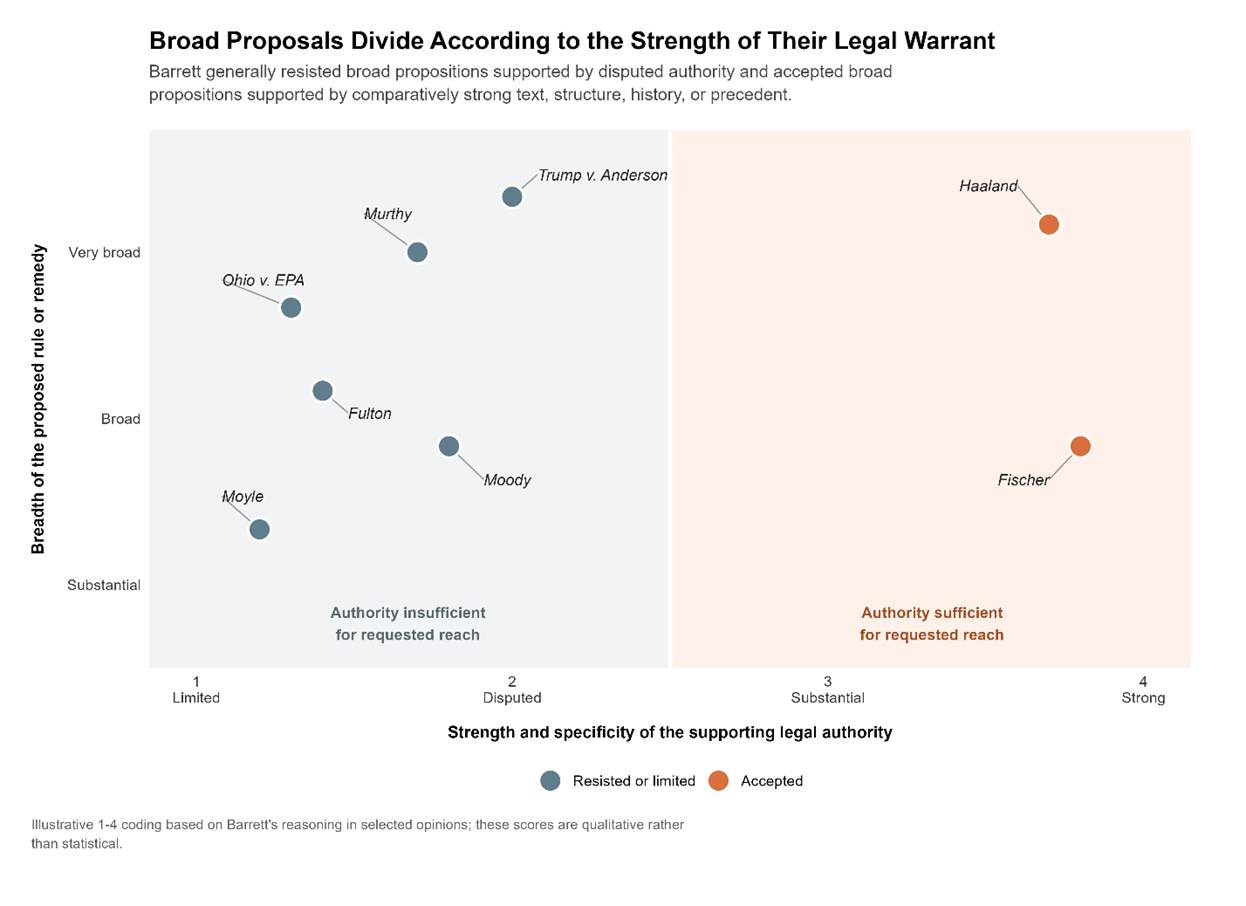
The map places selected propositions Barrett evaluated according to their breadth and the strength of the supporting authority she identified. She generally resisted broad propositions supported by disputed or incomplete authority and accepted broad propositions when she found the governing text, structure, history, or precedent sufficiently strong.
What the Pattern Explains
The familiar accounts of Barrett’s jurisprudence each describe part of her record. Her work with Scalia helps explain a commitment to enacted text, original meaning, and skepticism toward judicial reliance on legislative purpose. Her academic background helps explain her attention to standing, remedies, appellate role, and the relationship between procedural posture and the questions a court may properly decide. Her generally conservative voting record establishes substantive preferences that remain visible across most issue areas.
Those influences do not fully explain the variation within her decisions. Textualism alone does not explain why Barrett repeatedly writes about the source of judicial power, the adequacy of a record, or the availability of a narrower procedural route. Proceduralism does not capture her calibration of historical evidence in Bruen, Samia, and Vidal. General conservatism does not explain her statutory position in Fischer, her dissent in Ohio, or her mixed coalitions in bankruptcy, administrative law, and commercial cases.
Source-sensitive decisional calibration connects those tendencies because it describes how Barrett moves from an interpretive premise to a judicial result. Text, history, precedent, institutional authority, and the record do not merely point toward an outcome; they establish how far the Court may extend its reasoning or remedy. A strong and specific source can support a consequential decision, while ambiguity, historical silence, an incomplete record, or an ill-suited procedural vehicle can justify a narrower result or separate opinion.
The framework also places limits on claims about her personal motivations. Barrett’s opinions and oral-argument questions provide no reliable way to measure the effect of religious belief, and attributing public-law decisions to that background would require evidence the judicial record does not supply. The observable evidence instead shows recurring legal questions, issue-conditioned coalitions, and repeated continuity between argument and writing.
The pattern is structured, although the analysis cannot reduce every vote to a single variable. Supreme Court Database categories combine disputes that differ substantially, ideological-direction codes fit some cases better than others, and several issue areas contain too few nonunanimous decisions for firm conclusions. The oral-argument comparison establishes association rather than causation because cases that produce separate opinions may present more unresolved questions from the beginning. These limits make the thesis narrower and more defensible: calibration explains the scope and architecture of Barrett’s reasoning more reliably than it predicts every bottom-line vote.
What to Watch in the Cases Ahead
Barrett’s future questions may provide an early indication of where she sees a source-to-reach problem. Repeated demands for the source of authority, the governing test, a limiting principle, evidence connecting the rule to the record, or an explanation of why a narrower path is unavailable can identify the issue most likely to organize a later concurrence or dissent.
Those signals should be interpreted differently from conventional measures of ideological alignment. A question about statutory breadth does not necessarily suggest that Barrett will favor the narrower interpretation, as Fischer demonstrates. A question about institutional restraint does not necessarily favor state authority, as Haaland demonstrates. The inquiry concerns whether the asserted legal source can support the proposed reach, and the answer may produce either a broad or limited result.
Issue area provides additional context. Judicial-power cases are likely to keep Barrett close to Kavanaugh and focused on standing, redressability, and remedial authority. First Amendment and historically grounded constitutional cases may continue to place her nearer Gorsuch while prompting separate methodological qualifications. Technical statutory and regulatory disputes remain the strongest candidates for unusual coalitions because textual boundaries, remedial provisions, and record-specific questions can displace the Court’s more familiar alignments.
The contrast between Ohio and Fischer therefore supplies more than an opening anecdote. Barrett resisted broad emergency action when, according to her position, the record and posture could not sustain it, then accepted broad statutory consequences when she believed the enacted language required them. Her jurisprudence becomes more coherent when those decisions are read as two parts of the same judicial instinct: identify the governing authority, determine what it can bear, and refuse to make either the source or the decision do more than the law permits.
Click here to read more from Legalytics…
Adam Feldman runs the litigation consulting company Optimized Legal Solutions LLC. Check out more of his writing at Legalytics and Empirical SCOTUS. For more information, write Adam at adam@feldmannet.com. Find him on Twitter: @AdamSFeldman.
The post Who Is Justice Barrett? appeared first on Above the Law.