
Remember when the Supreme Court was absolutely consumed with figuring out who leaked the Dobbs draft opinion? They assigned the Marshal to investigate, brought in outside help, and made scores of employees sign affidavits. The response was immediate, muscular, and deeply unserious. The investigation did basically everything except interview the justices, because why interview anyone with both opportunity AND motive? Say, a justice credibly accused of leaking the results of other decisions who might have feared that colleagues would water down the maximalist draft before the case came down? No need to check in on anyone like that!
A witchhunt ironically launched to defend an opinion based on witchhunters. And after several months, it inevitably fizzled. It was we’re all trying to find the guy who did this meme if the cops just accepted the man in the hot dog costume at his word.
Well, it turns out they might’ve spent less time worrying about threats from inside the building and more time assessing how easily someone could waltz in through the digital front door.
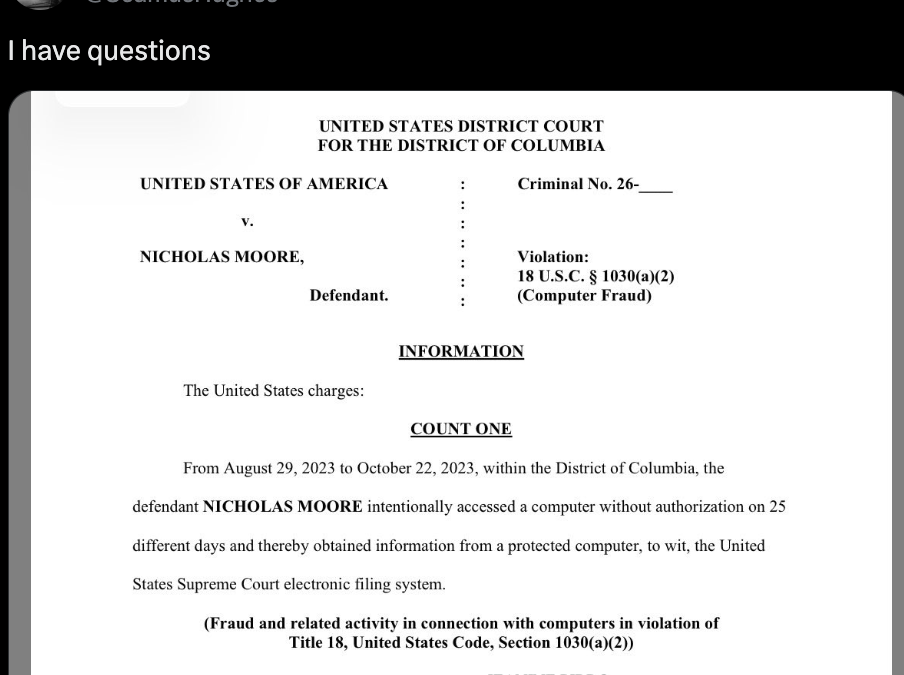
A 24-year-old from Springfield, Tennessee, named Nicholas Moore is set to plead guilty to hacking the Supreme Court’s electronic filing system. Not once or twice, but 25 times over a two-month span. If the Supreme Court didn’t know he was hanging out in the system for two months, is it still trespassing? When does adverse possession kick in?
Court Watch’s Seamus Hughes, who first spotted the filing, posted his reaction on X:
Indeed.
The filing is notably spare on details. Maybe Jeanine Pirro learned that less is more if she needed to pursue an indictment without D.C. grand jurors responding with a resounding, “Are you kidding, lady?” The former Fox News personality who now serves as U.S. Attorney has had a rough go of it in D.C., between the juries refusing to convict and judges openly questioning whether her office understands basic Fourth Amendment principles — but now she’s found a case where the defendant is just going to plead guilty and save her the risk of another embarrassing fail.
The charge itself rests on the Computer Fraud and Abuse Act, a statute prosecutors love the way DIYers love duct tape. The CFAA is intended to put sophisticated hackers in prison, but in practice, prosecutors deploy it whenever a computer makes someone feel bad. Its vague “unauthorized access” language has become a hammer used against people for logging into computers when company policy should have blocked access. It’s a computer crime law written for an era where our grasp of the technology came from movies like The Net, with that girl from the bus.
Did Moore maliciously hack into the system, or did he just walk blithely through an open door? Unfortunately, it wouldn’t matter much under the CFAA. Prosecutors told TechCrunch they “cannot provide any more information that hasn’t already been made public.” But based on the bare-bones of the Information, the defendant only gained access to the electronic filing system as opposed to the Court’s emails or document management system. Moore presumably wasn’t getting access to internal deliberations or Clarence Thomas’s next billionaire-funded luxury vacation through the filing system.
Not to downplay the seriousness of the breach — insider access to the filing system would afford access to any sealed documents — but this doesn’t sound like the start of a future Dobbs leak.
This marks the latest humiliating incident for the federal judiciary’s cybersecurity prowess. Last August, we learned that Russian government hackers had breached the broader federal court filing system. After years of claiming that PACER was a multibillion-dollar endeavor — before we learned that it was basically a federal judiciary slush fund — the federal judiciary belatedly committed to beefing up cybersecurity. This case serves as a reminder of how behind the times the judiciary was in 2023.
Are they any better in 2026? If they approached cybersecurity with the same vim and vigor they brought to revamping the Court’s ethical code, let’s say no.
Man to plead guilty to hacking US Supreme Court filing system [TechCrunch]
Earlier: PACER Gets Pwned: Hackers Breach Dinosaur Filing System
Everything You Need To Know About The Supreme Court Leak Report But The Justices Were Afraid To Ask
No Bills Are Only The Beginning Of Jeanine Pirro’s F-Ups
‘Do You Have A Lot Of Trouble Answering Questions Generally In Life Or Just When You Come In Front Of The Court?’
 Joe Patrice is a senior editor at Above the Law and co-host of Thinking Like A Lawyer. Feel free to email any tips, questions, or comments. Follow him on Twitter or Bluesky if you’re interested in law, politics, and a healthy dose of college sports news. Joe also serves as a Managing Director at RPN Executive Search.
The post Supreme Court Hacked, Proving Its Cybersecurity Is As Robust As Its Ethical Code appeared first on Above the Law.