
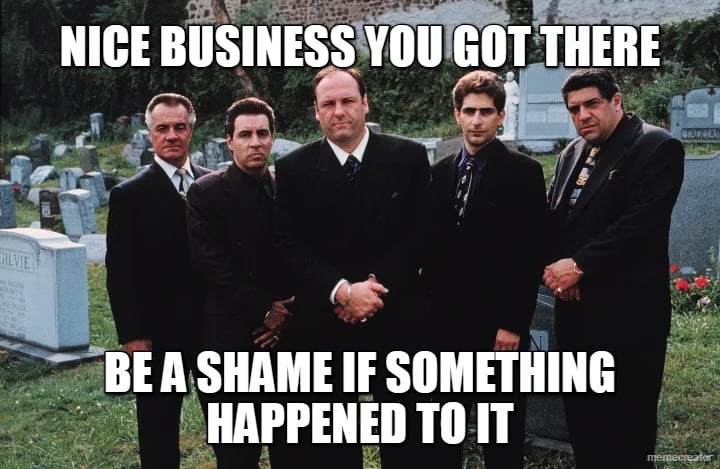
Ever since Kirkland & Ellis signed up for its $125 million pro bono payola deal in April 2025, the world’s richest law firm has had one answer to everyone who asked what it actually promised Donald Trump: a politely worded shrug. Now, a year and a half and six congressional letters later, we finally have numbers.
Quick refresher for anyone who blocked out early 2025: weeks into his second term, Trump started issuing executive orders against Biglaw firms he decided had crossed him. Those orders told agency heads to strip lawyers’ security clearances, restrict personnel from accessing federal buildings, and slash federal contracts held by the firms’ clients. The four firms that sued — Perkins Coie, Jenner & Block, WilmerHale, and Susman Godfrey — are doing victory laps in court. But nine other firms took a different route. Paul, Weiss went first, and Trump rescinded the order against Paul, Weiss after it agreed to provide $40 million in pro bono work for conservatice causes. Then came Skadden, Willkie, Milbank, and Cadwalader, then Kirkland, Latham, Simpson Thacher, and A&O Shearman. The final tally was $940 million collectively in pro bono help toward causes supported by Trump, the war chest we’ve been calling pro bono payola ever since.
New reports from the New York Times and MS NOW are both based on a seven-page letter Kirkland sent to congressional Democrats on November 5, signed by the firm’s outside counsel, Beth Wilkinson. As of Oct. 28, Kirkland had logged about 6,491 hours of free work for the Trump administration, valued at $11.8 million. The Commerce Department got the biggest share. The rest went to the Pentagon, the Postal Service, the U.S. International Development Finance Corporation, and 1,071 hours to an investment entity created under a U.S.-Japan trade memorandum. The firm also counts another $18.7 million in free work for outside clients in the causes Trump listed when he announced the deal. So much for Kirkland’s pro bono going to “a wide range of underserved populations.” Apparently the Department of Defense and its $1.01 trillion budget counts.
The Times also got its hands on how the deal got made. Kirkland partner Mark Filip was scrambling to head off an executive order, and Boris Epshteyn, Trump’s lead personal lawyer and de facto enforcer, didn’t have to do much negotiating:
EPSHTEYN: You have a big trade practice, right?
FILIP: Please call.
It’s giving…
For the record, Kirkland’s letter denies any quid pro quo, “or even the discussion of such an agreement.”
Remember, pro bono exists so people who can’t afford a lawyer get one anyway: the tenant facing eviction, the asylum seeker, the death row inmate with a deadline. ABA Model Rule 6.1 says most of a lawyer’s pro bono should go to “persons of limited means” or the organizations that serve them. It does carve out free work for governmental organizations, but only “where the payment of standard legal fees would significantly deplete the organization’s economic resources or would be otherwise inappropriate.” The Commerce Department has a budget in the billions. The Pentagon has a budget bigger than most countries. Neither is going to be wiped out by a Kirkland invoice. And as we pointed out when the Commerce work first surfaced, the federal government isn’t indigent, and ethics experts weren’t buying the pro bono label then either.
And pro bono is zero-sum, firms only have so many hours they’re willing to write off. Kirkland says it kept representing transgender inmates for free, which is real pro bono, it’s just also now competing for hours with the Commerce Department.
Then there’s the legal problem Democrats have been raising since jump: the Antideficiency Act. Congress controls the purse, and the executive branch generally can’t accept free services to do things lawmakers haven’t paid for and can’t oversee. Zachary Price, a law professor and expert on congressional appropriations, told the Times the arrangement “certainly violates the spirit of the law.”
“It amounts to expanded resources available for the executive without Congress providing them,” Price said.
Kirkland’s response:
“First, the act does not apply where there is an agreement that the services will be provided for free, as there was here,” the firm said. “Second, the Antideficiency Act regulates the conduct of executive branch officials, not private parties like Kirkland.”
Sure, Jan.
Kirkland did hand over its April 2025 communications with administration officials, its retention agreements for the government matters, and a breakdown of the hours. What it doesn’t have is the deal itself. Wilkinson told lawmakers there is no written agreement with Trump beyond his Truth Social post, and that the administration has never asked Kirkland to show it has met its commitments. That’s a $125 million obligation, documented in a Truth Social post and enforced on the honor system.
The most damning part of the letter is Kirkland explaining why it folded:
“It would be rational for clients with matters before the federal government — be it transactions being reviewed for approval, investigations by agencies, or requests for product, device, or drug approvals — to not engage firms where they perceived the potential for adverse consequences solely on their choice of counsel,” the firm wrote.
That’s a description of a shakedown, written by the people who got shaken down. The letter also says the Paul, Weiss deal “set forth a precedent” for how firms could avoid “immediately irreparable harm.” It lays out the cast, too. Kirkland hired Ballard Partners, the lobbying firm close to the White House, which opened talks with then-White House official May Mailman. From there, Filip and William Burck negotiated alongside representatives of A&O Shearman, Latham & Watkins, and Simpson Thacher. That fits neatly with earlier reporting that Kirkland was trying to rope a “critical mass” of Biglaw into caving alongside it. Across the table sat Mailman, then-EEOC chair Andrea Lucas, and Epshteyn. MS NOW notes this is the first time any firm has confirmed Epshteyn’s role.
To prove it still has a spine, Kirkland lists what it turned down. That includes the “Trump accounts” program, the census, the Kennedy Center renaming, and the Postal Service fight over mail-in ballots. It also passed on representing a veterans group backing Trump’s triumphal arch and scientists in climate change litigation. Congratulations on not helping the Postal Service restrict mail-in ballots. The bar is on the floor and Kirkland would like a medal for stepping over it.
The letter doesn’t explain why Kirkland, after five rounds of blanking Congress, finally answered a sixth request from lawmakers who still don’t have subpoena power. It does have a date on it: two days after the midterms handed Democrats both chambers.
Funny what an election will do.
On Thursday, Senator Richard Blumenthal, Senator Adam Schiff, and Representative Jamie Raskin sent letters to the eight other firms that cut deals, plus Sullivan & Cromwell. Each firm must list every request for “free or discounted legal services” it has received since its agreement by Dec. 2, and answer the rest of the lawmakers’ questions by Dec. 16. “The administration’s tactics smacked of implicit or overt threats, and we need to understand what led these other firms to capitulate,” Blumenthal told the Times. Meanwhile, in the ABA’s lawsuit over the administration’s “Law Firm Intimidation Policy,” a federal judge ordered the administration earlier this week to collect information about the deal negotiations from the firms, with documents due in late December.
It’ll be interesting to see what else about these deals finally gets revealed in December.
Earlier: Five Top Biglaw Firms Pledge Their Allegiance To Trump, Promising To Provide Legal Services ‘Beyond’ His Time In The White House
Not Content To Sell Out Their Own Principles, Kirkland Wanted All Of Biglaw To Sell Out
Paul Weiss & Kirkland Doing Free Trump Commerce Department Work As Part Of ‘Please Don’t Hurt Us, Daddy’ Deals
Lawmakers Ask Paul Weiss And Kirkland To Explain Why Trump Work Isn’t Totally Illegal
Simpson Thacher Becomes Latest Surrender Firm To Join Up With Trump’s International House Of Tariffs
New Lawsuit Seeks To Find Out What Exactly Is Up With Capitulating Biglaw Firms’ Deals With Trump
Democrats To Kirkland & Ellis For The Fourth Time: What Exactly Did You Promise Trump?
Skadden Said Its Trump Deal Raised No Ethical Issues. Intel’s Shareholders Disagree.
Biglaw Firms That Cut Deals With Trump Are AWOL As Midterm Election Fights Heat Up
Kathryn Rubino is a Senior Editor at Above the Law, host of The Jabot podcast, and co-host of Thinking Like A Lawyer. AtL tipsters are the best, so please connect with her. Feel free to email her with any tips, questions, or comments and follow her on Twitter @Kathryn1 or Bluesky @Kathryn1
The post Kirkland’s $125 Million Trump Deal Was Never Written Down, But The Hours Sure Were appeared first on Above the Law.