If there’s one figure in American history who would not stand for any of the present nonsense, it’d be Thomas Paine. The revolutionary pamphleteer hated the idea of monarchs trampling on people behind the veil of absolute immunity so much that he followed up the American Revolution by rolling over to France and getting elected to the revolutionary government without knowing how to speak French. Then he languished in prison as an opponent of the Robespierre administration and came home to write letters bashing George Washington. Thomas Paine had exactly zero tolerance for executive bullshit. So, obviously, the author of Trump v. United States invoked Paine as a political mascot to gaslight the American people into thinking any of this is normal.
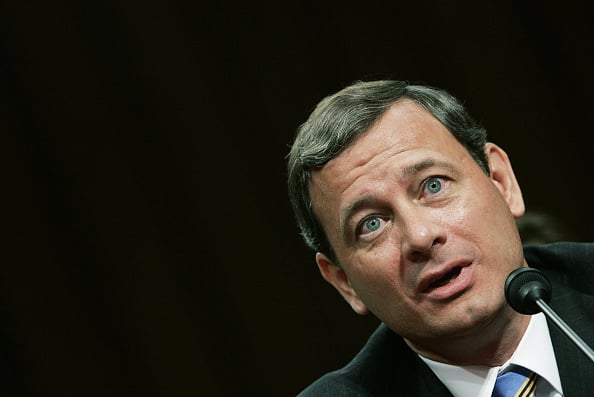
Every year, Chief Justice John Roberts releases his Year-End Report on the Federal Judiciary, and every year it reads like a college sophomore pulling an all-nighter to deliver a 10-page essay without doing the reading. What is there to say about the state of the federal judiciary as 2025 drew to a close? A massive uptick in violent threats against judges? Multiple instances of federal government lawyers caught lying to the courts? An historic lowpoint for public faith in the Supreme Court?
Roberts will discuss none of those topics. While not as far afield as his 2023 report, which devoted several pages to the advent of typewriters, the 2025 Annual Report provides an equally empty Temu history lesson, with Roberts hiding behind the sort of phony portrait of Thomas Paine’s life and work that only a true #Originalist could concoct.
Two hundred fifty years ago this week, a recent immigrant to Britain’s North American colonies put the finishing touches on a manuscript in which he hoped to express “plain truths” about his newly adopted home.
Immigrants get the job done, eh? Thomas Frank wrote an essay in the Baffler back in the 90s suggesting that the problem with protest art is that it’s aesthetic qualities will always end with it getting repurposed to support the status quo. It’s why Donald Trump is celebrating dropping bombs on Venezuela to the tune of Fortunate Son — a song explicitly about rich people sending regular folks to die in wars for their own personal enrichment. The sad legacy of Hamilton will almost assuredly be its cooptation into the sort of “good immigrant” mythologizing that guys like Roberts cite while simultaneously nodding gravely at the unfortunate necessity of Kavanaugh stops to round up everyone by skin color. Common Sense was, quite literally, a screed against a monarch who believed he could do whatever he wanted. Roberts has spent the last year rubber-stamping the worldview that King George’s only crime was not replacing William Pitt with Stephen Miller.
Professor Steve Vladeck, commenting on the Roberts report, took a much more gracious reading of the Roberts report:
Against that backdrop, the 2025 year-end report is fascinating for its subtleties. Reading between the lines, one can find the Chief Justice of the United States standing up for immigrants; extolling the continuing aspirations of the Declaration of Independence; and reiterating the importance of judicial independence—three messages that are certainly welcome as we look ahead to the second year of the second Trump administration. The problem, though, is that one has to read between the lines to find those takeaways. Given the year that just transpired—not just the substantive behavior of the executive branch but its unprecedented hostility toward, threats against, and defiance of federal judges—this would’ve been a golden opportunity for Chief Justice Roberts to make the kind of statement that might’ve resonated across the political/ideological spectrum. By opting for subtlety, it seems worth asking exactly who the Chief Justice views as his audience these days. Not only am I increasingly unsure of the answer, but, far more importantly, I wonder if he might be, too.
It would be nice if Roberts were just too weak and subtle to meet the moment. But Chuck Schumer already has that job. Where Vladeck sees positive signals, I see the ongoing effort to recast American history to support the contemporary right-wing political project that Roberts has worked to impose on the country.
Paine is a prop. This report is filled with props. When James Clavell wasn’t writing thousand-page doorstops about feudal Japan, he put out a short story about the path to fascism being paved by rituals like the Pledge of Allegiance. Tyrants can’t just roll in and make people forget what their country is all about, but they can systematically repurpose symbols when they’ve become deified by unquestioning masses.
Paine — a hero! — inspired the Declaration of Independence. Everyone knows that the Declaration of Independence is “good,” right? But before anyone tries to draw any broad conclusions about the Framers opposing occupying troops flooding the streets, remember the Declaration, for all its “good”-ness, is merely ancillary.
This may come as a surprise to some readers. But, as Justice Scalia observed, the Declaration consists of “aspirations” and “philosophizing” that do not lend themselves well to prescription or enforcement.
When rights are inconvenient, they always become “aspirational.” But Roberts does acknowledge the Reconstruction Amendments for attempting to convert the Declaration’s promises into something concrete.
That work began with the Thirteenth Amendment abolishing slavery. Lincoln lived to see that amendment pass both the Senate and the House, though it was not ratified until after his assassination. As the British philosopher John Stuart Mill observed, with the adoption of the Thirteenth Amendment, “the opening words of the Declaration of Independence” would no longer be “a reproach to the nation
founded by its authors.” The Fourteenth and Fifteenth Amendments soon followed, guaranteeing due process and equal protection of the law and granting the right to vote to Black men.
Note how the abolition of slavery gets top billing and the “actual promise of equality and the right to vote” are relegated to afterthoughts. That’s a feature not a bug for the guy who declared racism a thing of the past while gutting the Voting Rights Act.
This is another juncture where I hope optimists like Vladeck are right, but suspect they are not. Roberts isn’t sending a coded message that this Court will respect the promises of the Reconstruction Amendments, he’s telling us that this Court “respects” those constitutional principles and anyone who suggests otherwise misunderstands the line between aspiration and reality. It’s Clavell’s Pledge of Allegiance all over again: you know we believe in the Fifteenth Amendment… so when we say it means the executive branch can purge state voter rolls based on race it’s only because we believe in it so much.
Roberts closes the report by assuring us that the Constitution and Declaration “remain firm and unshaken,” quoting Great Depression architect Calvin Coolidge. This is framed as offering solace to the public, but it’s the opiate. The fixed stars of the American constellation are firm and unshaken because it’s un-American to question whether political operatives using the Court to erase a century — or more — of precedent might shake those foundations. Joyce Vance noted that the report opens with a photo of an empty room, an appropriate choice for a report casting American legal history as empty signifiers to be filled in by his majority.
Maybe that’s not what he’s trying to say. But if it’s not, he’s invited to drop the subtlety and write something straightforward and principled. Like Tom Paine would’ve.
(Report on the next page…)
Earlier: Chief Justice John Roberts Thinks You’re Stupid And He’s Probably Right
John Roberts Once Again Uses Judiciary’s Annual Report To Express His Utmost Contempt For The Public
Chief Justice’s Annual Report Recounts 65-Year-Old Tale Of Judicial Heroism To Remind You There Isn’t Any Today
Joe Patrice is a senior editor at Above the Law and co-host of Thinking Like A Lawyer. Feel free to email any tips, questions, or comments. Follow him on Twitter or Bluesky if you’re interested in law, politics, and a healthy dose of college sports news. Joe also serves as a Managing Director at RPN Executive Search.
The post Chief Justice Roberts Explains Why Thomas Paine Would LOVE Presidential Immunity And Troops Patrolling Streets, Actually appeared first on Above the Law.