
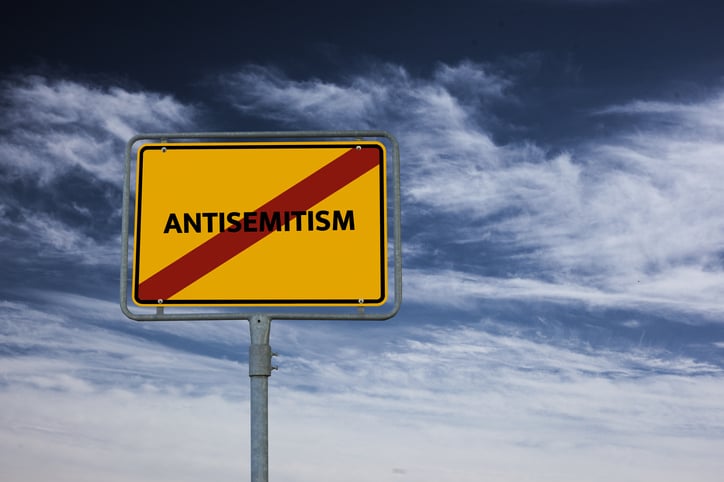
We were Jews before we were anything else, one Pennsylvania Supreme Court Justice remarked at a Democratic Jewish event in Philadelphia on October 6, 2025. The justice, then a candidate for retention election, spoke about our moral obligation to condemn antisemitism, particularly as we approached the second anniversary of October 7, 2023, the largest massacre of Jews since the Holocaust. It was a rousing Zionist speech and a call to action. But some attendees weren’t thrilled.
Several non-Jews told me the justice “shouldn’t be retained if he believes that.” But he protects their religious freedoms from the bench, fairly and impartially interpreting the law. His religious beliefs should be respected, too.
Was that exchange antisemitic? Anti-Zionist? Is there a difference? Even Jews disagree. But most Jews do agree that antisemitism is surging — more than 55% of us experienced antisemitism in the past year — yet our subjective experiences of anti-Jewish hate are often minimized or downright dismissed.
I can’t hide my Judaism, nor do I wish to: my Hebrew name gives me away immediately. My grandmother was a Holocaust survivor who passed away a few years ago; and my cousin’s husband is an Israeli Defense Force (IDF) soldier. Particularly since October 7, 2023, I’ve used my large platform to ensure the Democratic, pro-Israel, millennial perspective is represented in public life. I have a moral obligation to keep my grandmother’s memory alive through storytelling. For most Jews, Israel is inextricably linked with the cultural significance of the Holocaust — the largest-ever genocide, when 6 million Jews were exterminated — and our larger Jewish story.
I don’t remember when I first learned about Israel or the Holocaust, because both are integral to the fabric of being Jewish. Israel as it exists today was founded in 1948, soon after the Holocaust. Afterward, many Jews emigrated to Israel — theoretically, a haven. Israel remains heavily populated by Holocaust survivors and their descendants. But Israel is surrounded by nations that hate it and seek to wipe it off the map. It exists in near-perpetual conflict with neighbors. Israel, the sole Middle East democracy, has the right to exist and defend itself against aggression.
As I was growing up in Montgomery County, Pennsylvania, my Jewish identity was a nonissue. But being Jewish in my grandmother’s generation in Europe was literally a death sentence. I’ve always been painfully aware that, were I born two generations ago in Nazi Europe, I probably would not have survived to adulthood. We’re just two generations removed from the Holocaust. It could happen again.
I’m a proud Zionist and Democrat. Yet Jews from my generation struggle to reconcile those identities, because the “progressive” position on Israel is, nonsensically, anti-Israel. I’ve dedicated my life and career to advocating for increased rights and protections for tens of thousands of vulnerable judicial branch employees who are exempt from all federal anti-discrimination laws, including laws against religious discrimination. Ironically, those I advocate for — law students and young lawyers — don’t necessarily believe I deserve those same rights, like religious freedom and anti-discrimination protection. My nonprofit’s work democratizing judicial clerkship information and opportunities takes me to law school campuses nationwide, where some students are willing to go without essential career information — even disinviting me as a speaker — just to make their anti-Zionist point. One of the last acceptable forms of discrimination is against Jews. And it’s particularly ironic coming from Democrats, who pride themselves on values like religious freedom, equality, minority rights, and freedom from discrimination — unless you’re Jewish.
This year, we witnessed the antisemitic murder of two Israeli embassy employees outside the Capital Jewish Museum in Washington, D.C.; an antisemitic flamethrower attack in Boulder, Colorado; and an antisemitic firebombing of Pennsylvania Jewish Governor Josh Shapiro’s residence on Passover. And last weekend, antisemitic terror claimed at least 16 lives in Sydney, Australia, including a Holocaust survivor, a rabbi, and a child, who were gunned down during a Hanukkah celebration at Bondi Beach.
Too many demonize Israel — not just its leader — fomenting hate and encouraging antisemitic violence like these attacks — wrongfully conflating the actions of Prime Minister Benjamin Netanyahu with the beliefs of all Israelis, and all Jews. Zionism — the belief that Israel has a right to exist — has become a dirty word. But anti-Zionism is just antisemitism with a new haircut. To oppose Israel’s right to exist as a Jewish state, when Israel is part of the fundamental fabric of Judaism, is antisemitic. Because when anti-Israel critics talk about destroying the Jewish state, that necessarily means killing millions of Jews. Hateful rhetoric inverted and weaponized the word “genocide” against Israel. Yet this term bears historical significance for Jews because of the Holocaust, the largest genocide in history, when 6 million Jews were exterminated — burned alive in ovens and suffocated in gas chambers — for the “crime” of being other.
Ironically, while many on the left rightfully advocate equality for other marginalized groups, apparently Jews — a religious minority — aren’t deserving of protection. Rights for you, unless you’re a Jew. Paradoxically, many quote Pastor Martin Niemoller’s poem, “First They Came,” a warning about speaking up for oppressed minorities before there’s no one left to speak for you, aimed at Trump administration policies — written about the Nazis following the Holocaust.
Some lack historical context about the Holocaust: according to one recent survey, one-fifth of people have never heard of the Holocaust. Many have never met a Holocaust survivor, nor heard their stories — especially considering the last are quickly dying out. Holocaust education is not taught in all public schools. If we do not learn from the past, we are doomed to repeat it.
We should not demonize an entire country for its leader’s actions — let alone an entire religion. Many Jews disagree with Netanyahu’s wartime tactics. Yet too many in the U.S. dangerously demonize Israel’s 10 million residents. Criticize Netanyahu without criticizing Israel. Plenty of us criticize President Donald Trump without criticizing all United States residents. We cannot hold all Israelis, let alone all Jews, responsible for Netanyahu’s actions, unless we all want to be held accountable for Trump’s actions. It’s a logical fallacy of deadly proportions.
I’ve experienced my share of religious intolerance. Last year, I worked with Michigan Law student leaders to host a clerkship transparency event with my nonprofit, The Legal Accountability Project (LAP). Then, I was basically disinvited as a speaker because of my religious views, evidenced by social media posts about Israel, antisemitism, and the Holocaust. The student leader said, Your views make students uncomfortable, and we have a lot of Muslim students at Michigan. But the event was to talk about judicial clerkships, not Israel. For students of all faiths and races. I was disheartened that law students — including some who aspire to be civil rights lawyers — tasked with defending religious and ideological freedom, and law clerks — a position where you’re expected to be impartial or take the judge’s position even if you disagree — couldn’t separate my religious beliefs from the topic of clerking. As a result, the entire student body at Michigan Law was precluded from learning candid clerkship information through a LAP event which, frankly, they need.
Disturbingly, too many elected leaders, on both the left and right, amplify virulent anti-Israel rhetoric and failed to condemn hateful campus protests that made universities inhospitable for Jewish students. It’s no wonder young progressives, including law students, share antisemitic views espoused by progressive icons. Misinformation spreads like wildfire on social media. Hateful rhetoric like, “From the river to the sea” and “Globalize the intifada” — which glorifies terror and normalizes antisemitism, and which inevitably lead to violence — are proudly chanted and amplified, rather than properly condemned. Violent, hateful rhetoric stokes violent, hateful acts. Both parties certainly bear responsibility, but frankly, I hold Democrats — my own party — to a higher standard, given their professed commitment to religious freedom, diversity, equity, and inclusion. While there’s only so much I can do to pressure Republicans to act, when it comes to Democratic politics, my vote is my voice.
The vocal minority may be the loudest voices, but their views do not represent the majority. Sadly, there are few outspoken advocates for Israel in Congress, particularly among Democrats — and too few Jewish elected leaders. My congressional delegation in Pennsylvania, for example, has no Jewish representation. Decisions about domestic and foreign policy impacting millions of Jews are made without Jews at the table.
Last weekend, we witnessed both a school shooting at Brown University and the attack in Sydney. Every elected official, cultural and local leader, and candidate for office should unequivocally condemn both. But while public figures get “likes” on social media for saying we should vote out anyone who prioritizes guns over people, the same must be true for antisemitic apologists, including Democrats.
Elected Democrats are partly responsible for failing to quell rising antisemitism — failing to both unequivocally affirm Israel’s right to exist and defend itself, and to educate the public that support for Israel is synonymous with religious freedom, minority rights, and democracy. We look to elected leaders to educate and uplift: they failed. Congress should use all the tools in the toolbox, including the bully pulpit, to combat antisemitism. Social media can be weaponized to spread hate. But it can also spread the truth, if elected leaders had more courage.
The tide will only turn when people of all faiths call out antisemitism. Jews are only 2% of the U.S. population; we need non-Jewish allies to stand with us. This obsession with demonizing Israel is not just wrongheaded: it’s hateful and dangerous. As lawyers, we’re encouraged to use our training to do justice. The enforcement levers of the Department of Justice and Department of Education should be used to investigate and prosecute antisemitic acts. Funds could be withheld from schools that fail to protect Jewish students, in a manner that ensures due process. We should support a national definition of antisemitism that includes anti-Zionism for the enforcement of federal anti-discrimination laws, including for Title VI investigations into universities, because equivocating around anti-Jew hate costs lives. And we should mandate Holocaust education in public schools nationwide, so the next generation learns tolerance of all faiths — including Judaism.
It’s easy to speak out following a tragedy. I’m sure many will, including those who fomented hate in the past. But we cannot wait until the next tragedy occurs to take a stand. You can criticize Israel’s leadership without demonizing an entire nation and putting millions of Jews worldwide at risk. Online spaces don’t facilitate nuance. But amplifying hateful speech and glorifying violence gets Jews killed. Words have consequences, and violent words lead to violent acts. Equivocating around antisemitism is deadly.
Aliza Shatzman is the President and Founder of The Legal Accountability Project, a nonprofit aimed at ensuring that law clerks have positive clerkship experiences, while extending support and resources to those who do not. She regularly writes and speaks about judicial accountability and clerkships. Reach out to her via email at Aliza.Shatzman@legalaccountabilityproject.org and follow her on Twitter @AlizaShatzman.
The post Anti-Zionism Is Antisemitism With A New Haircut appeared first on Above the Law.