

Artificial intelligence is driving fundamental changes in legal practice, accelerating research, speeding up document analysis, automating drafting, and disrupting the traditional billable-hour business model. But AI is no cure-all.
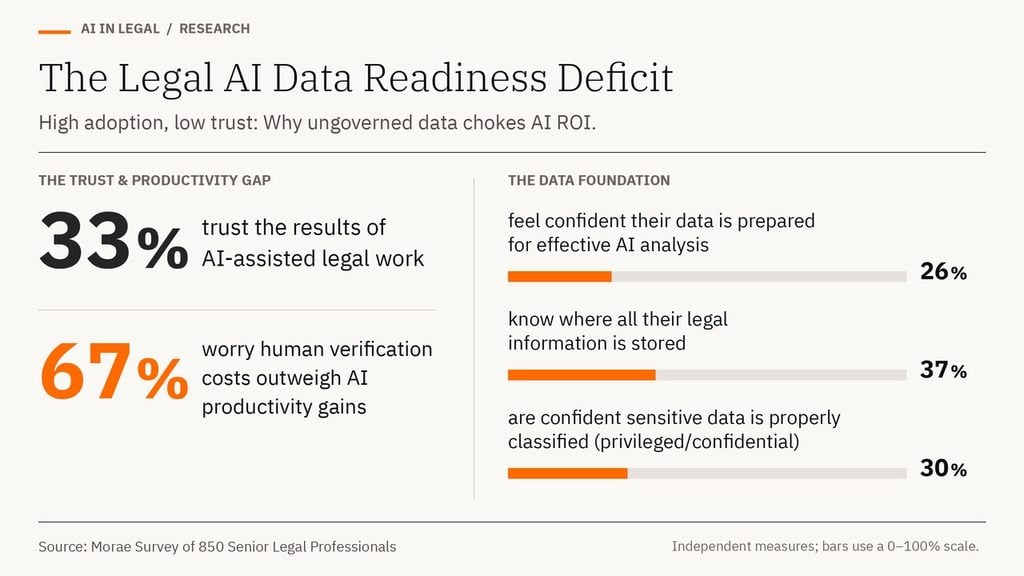
A recent Morae survey found that two-thirds of legal professionals say checking AI output is eating into the promised productivity gains. And likewise, a recent survey by researchers from the Federal Reserve Bank of Atlanta, Stanford University, the Bank of England, and the Autonomous Technological Institute of Mexico of nearly 6,000 business executives found that while most use AI, 90% reported no impact on employment or productivity. At least, not yet.
Here’s what we’re seeing: AI has shifted more work up the ladder. Where a partner once reviewed the work of two or three associates, AI can now generate four or five times as much material, and all of it still needs a seasoned eye. The review burden has landed on the most expensive people in the building.
The issue here is not the performance of large language models, which are improving at an astonishing rate. The issue is trust. In high-stakes legal work, blindly relying on AI output isn’t an option. The nuanced nature of the law means we can’t remove humans from the loop. The future will pair AI’s power to review and analyze documents with seasoned human supervision.
That approach is core to MorAI Spend Intelligence, the first module of Morae’s new legal intelligence platform. MorAI Spend Intelligence combines billing-trained AI with expert human review, providing corporate legal clients with valuable insights on their spending on legal counsel. In one early deployment with a global insurer, pairing AI with expert review doubled outside counsel savings, from 8.5% to 18%, and eliminated 14,000 hours of manual invoice review.
The obvious question is whether paying for human review cancels out the savings. It doesn’t, and we’re confident enough to put money on it: one of our pricing models is to receive a share of the savings we deliver, rather than a flat subscription.
While AI is central to this process, there are three points where humans play an important role.
Checkpoint one: Validation
While MorAI Spend Intelligence software can flag issues across every invoice line, legal and billing specialists confirm the findings before they reach the client. The software might conclude that a particular task should have taken three hours, rather than the eight hours billed. The human reviewer, well acquainted with the matter, might set the realistic figure at five hours.
Think of the reviewers as a circuit breaker. A flag that’s wrong, and goes to a law firm anyway, costs the client credibility. A flag checked by someone familiar with the matter and the firm is one the client can stand behind.
Checkpoint two: Making the tough call
Because in-house lawyers have long relationships with outside firms, overbilling often gets waved through. A third party enforcing billing guidelines takes the friction out. And violations aren’t always subtle: we’ve seen partners bill for photocopying, work more likely and appropriately handled by lower paid team members. With MorAI Spend Intelligence, our team contacts firms about billing issues and manages any disputes, so clients keep their firm relationships intact.
And to be clear, law firms benefit, too. Disputed invoices that once cycled back and forth for months get resolved faster, which means firms get paid sooner.
Checkpoint three: Humans make the decisions
With our approach, validated data provides the basis for insights into billing patterns, staffing mix, and budget overruns, along with leverage for renegotiating rates. But the system itself simply recommends potential actions. It is the general counsel who decides when and how to push back. That’s a place for deliberate decision-making, not an automated workflow.
Maintaining data integrity
Human review also plays an important role in keeping the data clean. Unvalidated data is expensive noise. Legal expense intelligence — and, in fact, all legal document analysis — is only as good as the data behind it. And the problem goes well beyond billing. Most legal organizations keep everything and dispose of almost nothing, so an AI tool is as likely to surface six-year-old board minutes as the document you actually need. That’s why contract review and information governance are next for us as we expand our platform.
The bottom line: while trust in AI will grow, the challenges will scale with the stakes. Low-risk work will be automated first. Higher stakes work will keep humans in the loop for years to come. It’s the bridge that will help legal teams capture AI’s gains today while building the verified data that will let them automate more work tomorrow.
Peter Fisher is the chief product officer at Morae, a legal managed services provider that gives corporate legal departments the people, technology and process to absorb budget and workload pressure without adding permanent resources.
The post AI Does Wonders. But Keep Humans In The Loop appeared first on Above the Law.